How Monochloramine is generated
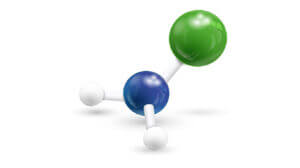
Monochloramine is produced through the reaction between a hypochlorous acid precursor and an ammonium source. To ensure maximum production yield and avoid the formation of unwanted by-products, the production system must ensure:
- Precise control of reaction stoichiometry: The correct balance of the two precursors is essential to ensure the formation of pure monochloramine.
- Maintaining an optimal pH value in the Reaction Solution at pH values above 7.0, the reaction is fully shifted towards the formation of monochloramine only.
Operating under appropriate pH conditions and adhering to the correct stoichiometry between the two precursors ensures that the process occurs as close as possible to the ideal situation, where the only by-product of monochloramine synthesis is water (H2O).
NH3+HOCl -> NH2Cl+H2O
On-site and in line production: A guarantee of efficiency and safety
Monochloramine must be produced on-site, meaning at the location and time of its use, due to its instability at high concentrations. On-site production and dosing of monochloramine directly into the water flow to be treated, in proportion to the amount of water being processed, is the solution that ensures optimal production results.
The two main advantages of this production method are:
- No accumulation in tanks: Accumulating monochloramine in a tank is not advisable, as it is unstable at high concentrations and may decompose, leading to a loss of concentration and the formation of by-products.
- Controlled and proportional dosing: By producing monochloramine directly in the water, it is possible to control the dosage and apply it proportionally to the volume being treated, ensuring a stable and controlled concentration of monochloramine.