In recent decades, monochloramine has become a valuable ally in ensuring microbiological safety in complex water systems, such as those in hospitals, public buildings, and industrial facilities.
However, its increasing use has also raised questions, doubts and, in some cases, outright fears. One of the most common: Can it cause allergies?
In this article, we address exactly that.
What is monochloramine and why is it used?
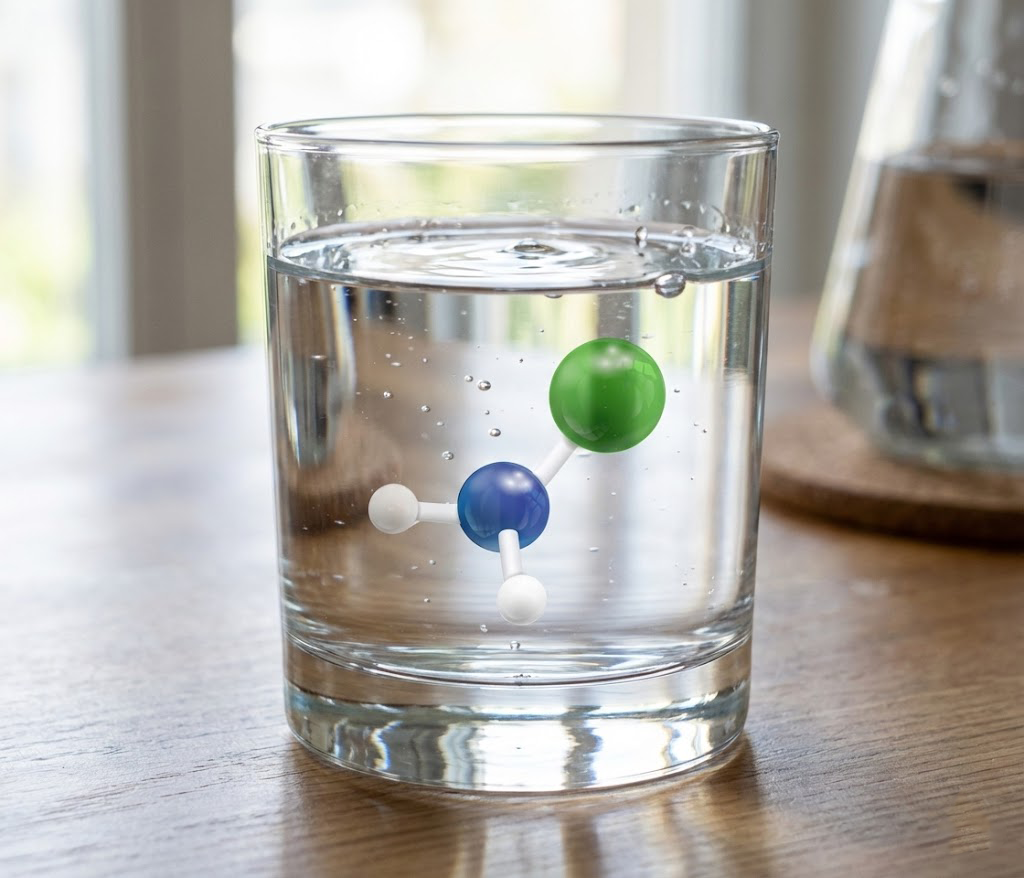
Monochloramine (NH₂Cl) is a secondary disinfectant used in complex water systems, such as municipal distribution networks, hospital and public building plumbing, and industrial plants.
Its main advantage lies in its ability to maintain stable, long-lasting disinfection, even in peripheral areas of the network where free chlorine tends to degrade more rapidly.
It is also preferred in many applications because it produces fewer unwanted by-products, such as trihalomethanes, and penetrates biofilm more effectively than other disinfectants.
Its use is recognised by international health authorities, including the World Health Organization, which recommends it for potable water disinfection, as well as in Legionella risk prevention guidelines, which highlight its effectiveness for treating building water systems.
How is monochloramine produced?
Monochloramine is formed through a controlled reaction between active chlorine (typically sodium hypochlorite) and an ammonium source.
Producing a stable and safe product requires maintaining a precise ratio between reagents and operating at suitable pH and temperature levels.
Professional generation processes are specifically designed to produce monochloramine selectively, avoiding the unwanted formation of dichloramine and trichloramine, which only occur under uncontrolled and suboptimal conditions.
Can monochloramine actually cause allergies?
The answer is clear: no.
There is no scientific evidence linking monochloramine to IgE-mediated allergic reactions.
Targeted scientific studies and epidemiological observations in real-world environments have never reported systemic or immunological effects attributable to monochloramine. On the contrary, technical documentation explicitly states that this molecule is not mutagenic, carcinogenic, teratogenic, or allergenic.
Even highly sensitive individuals—such as children, the elderly, or the immunocompromised—show no contraindications when exposed to concentrations used in practice, which always remain within the 3 mg/L limit set by the WHO as safe.
In the United States, where monochloramine has been in use for over a century, the Centers for Disease Control and Prevention (CDC) have conducted investigations to assess any potential correlation between monochloramine use and skin allergies. The US Environmental Protection Agency (EPA) reports that all such investigations have consistently concluded there is no cause-and-effect relationship.
Where does the confusion come from?
Misunderstandings often arise because the term “chloramines” is used generically, covering a class of chemically distinct molecules. This group includes, in addition to monochloramine, other compounds that can indeed cause undesirable effects, such as:
-
Dichloramine (NHCl₂)
-
Trichloramine (NCl₃)
-
Chloramine-T (Na⁺ [p-Me-C₆H₄-SO₂-N-Cl]⁻)
Monochloramine, dichloramine, trichloramine, chloramine-T: not the same thing
Monochloramine is a stable, low-volatility molecule, which allows it to remain dissolved in water and persist for extended periods.
By contrast, dichloramine and trichloramine are unstable and more volatile, forming through uncontrolled chemical reactions between chlorine and nitrogen—most commonly, in the case of dichloramine, in swimming pool water. These are the actual compounds responsible for the irritative effects often wrongly attributed to “chloramines” in general, and are far more commonly linked to non-potable water exposure.
Chloramine-T, often confused with monochloramine because of its name, is a disinfectant not authorised for potable water treatment and is known to cause irritation and allergic reactions, especially through direct contact or inhalation. Misuse can cause significant skin and respiratory tract irritation and, in more severe cases, lead to skin sensitisation or asthma.
What do the regulations say?
International health authorities, starting with the World Health Organization, state that monochloramine can be safely used at concentrations of up to 3 mg/L in drinking water. This limit applies equally to vulnerable groups, including newborns, pregnant women, and the immunocompromised.
So, should you be concerned?
No. Monochloramine is a safe, technically controllable disinfectant solution.
Concerns about allergies or discomfort are almost always the result of an improper generalisation between different chlorinated substances.
The science is unequivocal: monochloramine is not an allergen, is not toxic, and is not volatile.
In fact, it is one of the most effective and well-tolerated solutions for continuous microbiological water quality control—not only in municipal water supplies, but also in highly critical environments such as hospitals, long-term care facilities, and industrial applications.