Given its characteristics and peculiarities, monochloramine proves to be the ideal disinfectant for multiple applications, ranging from the control of *Legionella* in internal building distribution networks to secondary disinfection in water supply systems and the treatment of industrial water. Its advantages can be summarised in 5 points:
1st Advantage: Monochloramine, the best disinfectant
Among the main advantages of monochloramine is certainly its disinfecting efficacy: due to its peculiar chemical characteristics, it can act selectively, specifically reacting with certain chemical groups present in the proteins of microorganisms, inhibiting their activity and causing the subsequent death of the cells.
Its broad-spectrum efficacy remains unaffected even in the presence of biofilm, which it can penetrate efficiently, or in the presence of compounds in the water that, with other disinfectants, contribute to their undesirable consumption, leading to the formation of reaction by-products that are often hazardous to health. Over the years, various scientific publications have demonstrated its efficacy not only against Legionella and Pseudomonas but also against other microorganisms that are more resistant to disinfection, such as mycobacteria, fungi, and amoebae.
In-depth analysis on “Legionella Prevention”
2nd Advantage: Maximum biofilm penetration
As mentioned in the previous paragraph, monochloramine, unlike other disinfectants, does not react with the extracellular matrix that constitutes the three-dimensional architecture of the biofilm, allowing it to diffuse through it and reach the deeper layers at substantially unchanged concentrations, making it effective against the microorganisms residing within. This mechanism of action, on one hand, prevents undesirable waste of disinfectant, which is consumed only in reaction with its specific target, namely the microorganisms.
On the other hand, it ensures a safe biofilm removal mechanism without undesirable effects: practical experiences demonstrate how monochloramine helps prevent the release of biofilm fragments containing viable (and therefore potentially harmful) cells. Deprived of its hosts, the biofilm gradually decomposes until it is completely removed, without any undesirable effects on the organoleptic qualities of the water.
In-depth analysis on “Biofilm Penetration”
3rd Advantage: No risk of corrosion
Corrosion and the weakening of metal or plastic pipes represent one of the main risks associated with the use of a disinfection system, both in the case of one-time high-concentration shocks and in continuous use. Strong oxidants like chlorine and chlorine dioxide are very aggressive towards all types of materials.
For this reason, their use can cause undesirable phenomena, such as the appearance of red water and the establishment of corrosive processes affecting metal components, which not only results in thinning of these components, with a consequent risk of breakage and leaks, but also leads to significant consumption of disinfectant. In areas where corrosive processes occur, most of the dosed biocide is consumed in these unwanted oxidation-reduction reactions, creating a vicious cycle that prompts a progressive increase in dosages, resulting in worsening corrosion without any improvement in microbiological control.
In the case of plastics, the effect of chlorine dioxide is particularly detrimental, as its dissolved nature allows it to diffuse into the network formed by the polymer chains, leading to the breakdown of the bonds that hold them together, literally causing the materials to crumble.
Thanks to its mild oxidising power and target specificity, monochloramine, on the contrary, does not chemically interact with metals and plastics, making it completely compatible even in cases of continuous and prolonged use.
In-depth analysis on “No Corrosion”
4th Advantage: Stability and Persistence
The chemical stability that characterises monochloramine is the reason behind its high persistence over time and space, a property that ensures an effective “residual effect” even in distribution networks characterised by long water residence times and underutilised or stagnating points, as well as in very extensive, long, or branched networks. It is worth noting that its half-life is approximately 10 times longer than that of chlorine and even 20 times longer than that of chlorine dioxide, even in hot water.
In-depth analysis on “High Stability”
5th Advantage: Absence of By-products
The use of monochloramine is often preferred for addressing issues related to the presence of by-products commonly encountered when dosing hypochlorite and chlorine dioxide (e.g., THMs, HAAs, chlorites, and chlorates). Various studies demonstrate that disinfection with monochloramine allows for a reduction in the concentration of by-products, facilitating compliance with the increasingly stringent limits imposed by Legislative Decree 18/2023 regarding drinking water quality. To better understand these considerations, in addition to referring to the aforementioned stability, which prevents non-specific reactions of the molecule with potential precursors of by-products present in the water, one can consider the equation that describes its synthesis reaction:
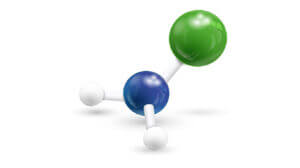
NH3+HOCl->NH2Cl+H2O
If the reaction is conducted, using appropriate technological solutions, under optimal controlled conditions in terms of pH and the concentration of the two precursors, the only by-product of the synthesis reaction is effectively water. However, to achieve such conditions, it is essential to have accurate control over the dosing of the two reagents to exclude the presence of residual chlorine and ammonia and to avoid storing monochloramine at high concentrations, as this condition favours its self-decomposition.